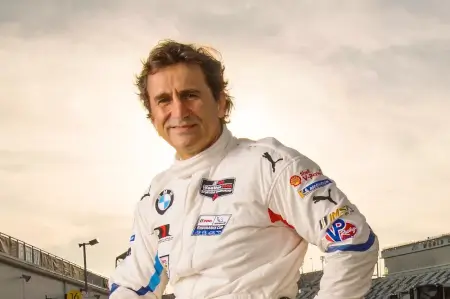




Alex Zanardi 1966 – 2026
As a Paralympian, Alex Zanardi became a household name and an inspiration to millions. But his indomitable spirit and speed in a racecar had already made him a hero.
After Alex Zanardi and the CART Indy car Safety Team felled the Grim Reaper back in September 2001, we thought he was indestructible. His success in the Paralympics surely proved it. Yet now he is gone and we are left devastated. What a man he was. What a hero he is.
Bologna-born Zanardi started racing a self-built kart in 1979, the same year his sister Cristina died in a streetcar accident. Naturally his parents became overprotective, but equally they could see that nothing could stop him from pursuing his dream, and they learned to have faith in what he rapidly proved to be a considerable talent. That saw him rise from karts to reach Italian Formula 3 in 1988. After showing promise and strong results, overachieving in an underpowered car, he graduated to Formula 3000 in 1991 with the Il Barone Rampante team.
A season-long battle with Christian Fittipaldi saw the Italian play a starring role – two wins, four runner-up finishes – but he came up slightly short in the points table at year’s end. However, by then he had become a Formula 1 driver. The fallout from the unsavory late-season Benetton/Jordan dispute over Michael Schumacher’s services involved Roberto Moreno being cast aside by both teams, and Eddie Jordan drafting Zanardi into his squad to partner Andrea de Cesaris for the final three F1 rounds. Zanardi scored two top-10 finishes (not worth points in those days) but was left on the sidelines for ’92, three more starts coming only as sub for the injured Fittipaldi at Minardi.
However, for 1993 Zanardi was signed full-time by Team Lotus, in the hallowed squad’s penultimate season of Grand Prix racing. Alongside the more experienced Johnny Herbert, Alex not only scored his first point – sixth place in Interlagos – he also proved himself a hard fighter in wheel-to-wheel battles. However, a huge shunt during practice for the Belgian Grand Prix at Spa-Francorchamps left him with neck injuries that curtailed his season.
He returned to action for the team in 1994 to sub for the injured Pedro Lamy – the man who had subbed for him after the Spa crash – but Lotus’s parlous financial state later obliged team management to drop him for a couple of events in order to run the well-funded Philippe Adams. The team submerged at season’s end.
He returned to action for the team in 1994 to sub for the injured Pedro Lamy – the man who had subbed for him after the Spa crash – but Lotus’s parlous financial state later obliged team management to drop him for a couple of events in order to run the well-funded Philippe Adams. The team submerged at season’s end.
With no more opportunities in F1, Zanardi killed time with some sportscar racing in ’95 but turned his attention to the U.S. open-wheel scene. Chip Ganassi, whose team had landed its first two CART Indy car wins in 1994, needed a partner for Jimmy Vasser in ’96 and duly signed the 29-year-old Italian.
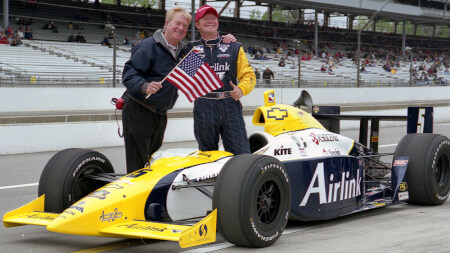
The timing was perfect for an ambitious driver whose career had in recent years become a patchwork of high promise and thwarted potential. Chip Ganassi Racing, which in the off-season had switched from Ford to Honda engines and from Goodyear to Firestone tires, now entered a golden era. Vasser won the ’96 championship, while his ever-improving rookie teammate earned three wins, six pole positions and third in the championship.
Zanardi’s technique meshed beautifully with cars that provided a great amount of “feel” to drivers as they tried to put 900hp to the ground. He proved he could monster the car in flamboyant manner or apply smooth inputs with great self-restraint. Whatever was required to extract the most from the tires, the car, the track and the moment, he would do it. As one of his most prominent fans, Mario Andretti explained it thus: “Alex was superb if everything was perfect, but even better if everything wasn’t.”
Zanardi’s natural aggression in competition raised the hackles of some drivers throughout his three seasons at Ganassi, but he took his lumps from both them and the stewards, and would firmly rebuff criticism whenever he felt wronged. Over the course of time he earned their respect. Alex also formed a lifelong bond with his teammate Vasser and a hugely productive relationship with his chief engineer, the former Ensign F1 team owner Mo Nunn.
As well as being appreciated by fans for his friendliness and approachability off-track, the in-cockpit aggression that needled his rivals was regarded by trackside and TV spectators as an admirable and exciting trait: he was simply irrepressible. This was never better demonstrated than in his famous pass on Bryan Herta to grab the lead on the last lap of the ’96 season finale at Laguna Seca, or his storm from the back of the field at Long Beach in 1998 to snatch an unlikely victory. Far more often than not across the ’97 and ’98 seasons, Zanardi was the man to beat – and no one could do it consistently enough to stop him racking up two straight championships and 12 more wins.
As well as being appreciated by fans for his friendliness and approachability off-track, the in-cockpit aggression that needled his rivals was regarded by trackside and TV spectators as an admirable and exciting trait: he was simply irrepressible. This was never better demonstrated than in his famous pass on Bryan Herta to grab the lead on the last lap of the ’96 season finale at Laguna Seca, or his storm from the back of the field at Long Beach in 1998 to snatch an unlikely victory. Far more often than not across the ’97 and ’98 seasons, Zanardi was the man to beat – and no one could do it consistently enough to stop him racking up two straight championships and 12 more wins.
As Zanardi fought for his life in 2020, one of his strongest rivals from the late 1990s, Dario Franchitti, tweeted: “He has defied the odds his whole life, always done the seemingly impossible. When we raced against each other, I realized there was never a point in any race that in his mind he was beaten.”
Yet despite loving the varied skillset required to be a successful Indy car driver and thoroughly enjoying Chip Ganassi’s ever responsive team environment, Alex couldn’t resist the call from Williams Formula 1 team to head back over the Atlantic for 1999… but it was not without a backward glance. In his brilliant 2004 autobiography, My Sweetest Victory, Zanardi wrote: “After my family and my parents, I am most grateful to Chip and wish that I had told him how much he impacted on my life. Needless to say, I went to drive my last race for him with a heavy heart.”
Throughout 1999, he doubtless continued to look wistfully at images of the beautiful Target-colored Ganassi Reynard-Honda he had left in the hands of his replacement, Juan Pablo Montoya. The Colombian rookie went on to nail the team’s fourth straight title. Zanardi failed even to score a point on his F1 return. The contrast was starker even than the Nigel Mansell/Michael Andretti transatlantic “swap” of six years earlier. Williams was going through a lull with the Renault-based Supertec engine in ’99, and Zanardi’s car had frequent reliability issues that hurt his chances of honing his car’s handling characteristics to best suit him. As a result, that season he was rarely on the qualifying pace of teammate Ralf Schumacher.
Alex admitted he loathed the grooved tires being used in F1 in that era, for they allowed hardly any time to work on setup before they went off. He also confessed that he wasted too much test and practice time – and too many tires – trying to adapt the Williams FW21 to his driving style, rather than adjusting his own modus operandi to fit with the optimal setup of the car.
For more information: www.racer.com
For more Industry News, please Click Here
For more information: www.racer.com
For more Industry News, please Click Here