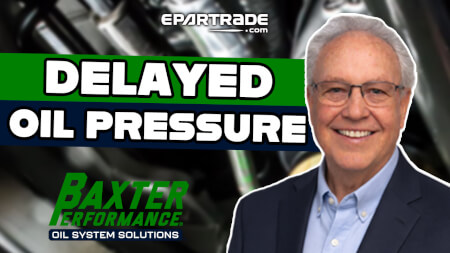




Delayed Engine Oil Pressure: Baxter Performance Presents Practical Solutions to Engine Wear
Race Industry Now Webinar – Featuring Kevin Baxter, President, Baxter Performance | Hosted by Brad Gillie (SiriusXM, Ch. 90, Late Shift)
In a recent episode of Race Industry Now, EPARTRADE’s weekly technical webinar series, Kevin Baxter, President of Baxter Performance, delivered a deep technical exploration into one of the most overlooked contributors to engine wear: delayed oil pressure at startup.
While often dismissed as a minor inconvenience, Baxter’s analysis reveals that oil drain-back and dry starts represent a significant mechanical vulnerability in modern engines, particularly those with complex valvetrain architectures and variable valve timing systems.
The Core Issue: Oil Drain-Back and Dry Start Conditions
Modern engines—especially those utilizing cartridge-style oil filters—can suffer from substantial oil drain-back after shutdown. Baxter highlighted real-world testing showing that:
- Certain engines (e.g., Pentastar 3.6L) can fully drain oil from critical passages in ~35 minutes
- Turbocharged EcoBoost engines may drain in as little as 18 minutes
- Upon restart, it can take up to 3.5 seconds for oil to reach upper valvetrain components
For a high-performance or modern production engine, this delay is not trivial.
During this window:
- Camshafts, lifters, and phasers operate under boundary lubrication or near-dry conditions
- Hydraulic systems (e.g., VVT) lack sufficient pressure to function properly
- Repeated start-stop cycles amplify wear exponentially
As Baxter emphasized, engine wear is driven more by the number of starts than total mileage.
Why Existing Systems Fall Short
A key takeaway from the webinar is that not all oil filtration systems provide true anti-drain-back functionality.
Contrary to common assumptions:
- Many cartridge filter systems lack active anti-drain-back valves
- Some OEM “solutions” are passive designs that do not prevent oil migration
- Even traditional spin-on filters with anti-drain-back valves can allow slow leakage over time
Through direct visualization—using modified filters with cameras and lighting—Baxter demonstrated that oil retention assumptions often do not reflect real-world behavior .
Engineering the Solution: Check Valves and Oil Retention
Baxter Performance’s approach centers on a fundamental principle:
Maintain oil within the system post-shutdown to reduce dry start duration.
Their patented adapter systems introduce:
- Outflow check valves to prevent reverse oil migration
- Improved oil retention within galleries and filter assemblies
- Faster oil pressure buildup at startup
Critically, Baxter noted that these systems:
- Do not restrict oil flow
- Maintain OEM pressure characteristics
- Integrate directly between the engine and oil filter with minimal modification
Beyond Retention: Clean and Efficient Oil Servicing
A secondary—but highly practical—innovation discussed during the webinar is Baxter’s EvacuFilter system, designed to improve oil service procedures.
Using a Schrader valve and compressed air, the system:
- Evacuates oil from the filter before removal
- Prevents spills and contamination
- Pushes residual oil from:
- Oil coolers
- Remote lines
- Internal cavities
This results in:
- Cleaner servicing
- More complete oil extraction
- Reduced residual contamination during oil changes
Real-World Impact: Valvetrain Wear and Engine Longevity
One of the most compelling parts of the presentation was physical evidence of wear:
- A camshaft from a 3.6L engine with only ~43,000 miles showed significant lobe wear
- The root cause: repeated dry start conditions, not high mileage
Modern engines—especially those with:
- Aggressive cam profiles
- High spring pressures
- Variable valve timing systems
…are particularly sensitive to lubrication delays.
As Baxter explained, these systems are mechanically violent environments, requiring immediate oil pressure to prevent accelerated wear.
A Shift in Perspective: Starts Matter More Than Miles
Perhaps the most important paradigm shift from the session:
Engine longevity is increasingly dictated by start cycles, not total mileage.
Short trips, stop-and-go driving, and hybrid operation modes (frequent engine restarts) all:
- Increase dry start frequency
- Compound wear mechanisms
- Expose limitations in OEM oil retention strategies
Designed for Integration, Built for Reliability
Baxter Performance’s solutions are engineered with:
- 6061-T6 anodized aluminum construction
- Viton sealing systems for chemical resistance and durability
- Compact, non-intrusive designs (~3/16” thickness)
- Compatibility across a wide range of filter sizes and engine platforms
All components are manufactured in the United States, with a focus on long-term reliability and system integrity.
Conclusion: Solving a Problem Hiding in Plain Sight
The webinar underscores a critical reality for racers, engine builders, and performance enthusiasts:
Delayed oil pressure is not a theoretical issue—it is measurable, repeatable, and consequential.
By combining:
- Real-world diagnostics
- Mechanical validation
- Practical engineering solutions
Baxter Performance is addressing a gap between OEM design constraints and real-world operating conditions.
For an industry increasingly focused on precision, efficiency, and longevity, this represents not just a product innovation—but a shift in how engine lubrication is understood and optimized.
For more information, watch the full webinar here.