



IndyCar IOB chairman Nair lays out plans to revamp series' rulebook and tech procedures
IndyCar Officiating Board chairman Raj Nair has elaborated on the IOB’s intention to complete a sweeping revision to IndyCar’s rulebook to eliminate oversights and confusion, which he cited as a factor in some of the rule violations that took place in recent seasons.
“We've also been looking at the rulebook and both the way it's written as well as the way it's reviewed and updated; that was certainly a factor that played into what happened over the last couple of years,” said Nair, who is joined on the IOB by Ray Evernham, whose expertise is lent to the technical side of the group, and the FIA’s Ronan Morgan, who brings decades of race stewarding experience.
“So although the rulebook’s fundamentally sound, it's not the most usable and accessible and searchable. And I would say not just the rulebook. There are aspects of technical bulletins that come out from our technical partners, whether it's on the engine side or on the chassis side, that aren't always captured in the rulebook.
“So in that aspect, we've got a concerted effort going on as we speak that would be probably rolling out through 2026 to improve the technical bulletin and alignment to the rulebook, as well as make that very easily accessible, not just to the officiating team, but everybody in the paddock.”
A growing number of IndyCar teams have purchased laser scanning machines – often from the same vendor used for tech inspection by sanctioning bodies – to scan their cars at the shop to ensure bodywork dimensions are within specification. Full-car scanning is the norm for series like NASCAR and IMSA, and as Nair detailed, it’s where the IOB intends to take IndyCar by 2028 when its new Dallara IR28 chassis debuts.
“[There’s] some equipment we're looking at,” he said. “We are currently one of the few series that I'm aware of that actually doesn't use scanning equipment as part of tech inspection. So we have an agreement to purchase some scanning equipment. We will a need a learning curve on that, on how to use that. Certainly in time for the new car, it'll be well in place and well-established. And certainly, you guys know what a big difference that made, particularly in NASCAR when I was in there (with Ford).hTat was a game-changer for NASCAR, on how tech worked, and how particularly body panel suppliers needed to really meet their manufacturing tolerances.”
Due to the widespread variances within the manufacturing tolerances throughout the current Dallara DW12 chassis which has undergone numerous updates since its introduction in 2012, Nair looks to the 2026 and 2027 seasons as the perfect opportunity to ramp up the IOB’s scanning capabilities before using the technology to determine the legality of the IR28s when they come online.
“We would like to get the scanning equipment purchased and up and running and start learning how to use it this year,” he continued. “But given [how] this car wasn't designed around that, and we've got a lot to learn on how to use it, it'll be more of a learning tool. And then through ’27, perhaps more into enforcement. And certainly in ’28, a key tool for enforcement, if not the key tool for enforcement.”
In the interim, the non-profit IndyCar Officiating group that houses the IOB will look to implement other enforcement tools to ensure the field of DW12s – some of which date back to the first years of production – comply with the regulations.
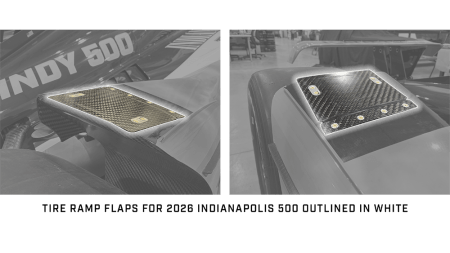
An increase in templating to measure bodywork – a new diffuser-exit underwing template was shown to the paddock at the recent Phoenix Raceway test – is one of the immediate changes in store for the series.
“[We] will continue to do things template-wise, measurement-wise, as we're gathering information,” Evernham said. “So before we get too far out, we don't want things to get too far away from us, either. [We] have discussions with Dallara, with both [engine] manufacturers, to make sure that the consistency and communication, which were the two things that we were charged with right off the bat, are going well, and you'll see more of that as time goes on and we are able to attack those priorities.
“But certainly we want to create that consistency, and the way that we can create that consistency right now is by working on templates and measuring and gathering that information.”
The IOB also completed its search for a new Indy NXT race director this week.
“John Maesky will be a superb addition to the Indy NXT race control,” Nair said. “As the board’s commitment to providing support and resources for IndyCar Officiating continues, John’s experience and prior work in officiating and operations will prove invaluable for IndyCar’s developmental series and its future. We are delighted to work with him in 2026.”
For more information: www.racer.com
For more Industry News, please Click Here
For more information: www.racer.com
For more Industry News, please Click Here