



Protecting the Powertrain: PPE Explains Engineering Behind Better Cooling, Filtration & Reliability
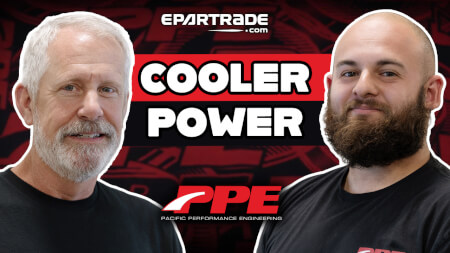
EPARTRADE Race Industry Now recently welcomed Pacific Performance Engineering (PPE) for an in-depth technical discussion on one of the most overlooked aspects of vehicle performance: keeping the powertrain alive under increasing thermal and mechanical loads.
Hosted by Brad Gillie from SiriusXM's Late Shift (Ch. 90), the webinar featured Eric Sempson, Product Support Manager, and Charles Lara, Sales Manager, who shared the engineering philosophy behind PPE's extensive lineup of cooling, lubrication, filtration and drivetrain products designed for diesel trucks and high-demand applications.
While horsepower often dominates conversations surrounding performance vehicles, PPE emphasized that reliability begins with controlling heat, maintaining clean lubricants and making routine maintenance easier. These engineering fundamentals ultimately determine whether a powertrain delivers consistent performance over hundreds of thousands of miles.
Engineering Solutions for Real-World Problems
Founded in 1985, PPE has grown from a small diesel performance manufacturer into a company offering hundreds of pages of products covering GM, Ford, Ram, Jeep, Toyota, Honda and numerous other applications.
Rather than designing products simply to increase performance, PPE engineers focus on solving common failure points encountered by truck owners, fleet operators, towing applications and performance enthusiasts.
Throughout the webinar, Sempson explained that nearly every product begins with identifying a weakness in an OEM design and then developing an engineering solution that improves durability, serviceability or thermal management.
"Our goal is to solve common problems before they become expensive repairs," he explained.
Heat: The Silent Enemy of the Powertrain
One of the webinar's central themes was heat management.
Whether discussing automatic transmissions, engine oil or differentials, PPE stressed that excessive operating temperatures accelerate fluid breakdown, reduce lubrication effectiveness and shorten component life.
Transmission temperatures are particularly critical in today's trucks, especially those used for towing heavy loads or operating in mountainous terrain.
To combat these conditions, PPE engineers developed larger-capacity transmission cooling systems designed to improve heat rejection without compromising fluid flow.
The company also discussed transmission bypass valve solutions that eliminate a common restriction found in certain OEM cooling circuits.
Many factory systems incorporate thermostatic bypass valves intended to accelerate warm-up by restricting flow through the transmission cooler until the fluid reaches a predetermined temperature. While effective for faster warm-up, these valves can become a single point of failure if they stick or malfunction.
PPE's engineering approach removes this restriction, allowing transmission fluid to circulate through the cooler continuously. The result is more consistent cooling under heavy-duty operation and fewer concerns about bypass valve failures limiting cooling capacity when it's needed most.
For trucks subjected to towing, performance driving or elevated ambient temperatures, maintaining continuous fluid circulation provides a significant advantage in thermal stability.
Improving Lubrication Through Better Filtration
The discussion then shifted toward lubrication system efficiency, where PPE challenged the assumption that all oil filters perform equally.
According to Sempson, filtration effectiveness depends not only on filter media quality but also on overall filter capacity.
For applications such as the 6.6L Duramax, PPE engineers developed significantly larger oil filters that provide substantially greater filtering surface area than many factory designs.
The increased media area allows oil to move through the filter at a lower velocity, giving contaminants more opportunity to be captured while simultaneously increasing dirt-holding capacity before restriction occurs.
Higher-quality filter media further improves particle capture efficiency, helping reduce abrasive wear throughout the engine.
For owners keeping trucks well beyond 100,000 miles—or using them in demanding commercial or towing environments—these seemingly small improvements can contribute to noticeably improved long-term engine durability.
Magnetic Filtration Adds Another Layer of Protection
Beyond conventional filtration, PPE incorporates high-temperature neodymium magnets into many of its transmission pans, engine oil pans and differential covers.
These powerful magnets continuously collect ferrous wear particles circulating within the lubricant.
Even microscopic metallic debris can contribute to accelerated wear if allowed to recirculate through bearings, gears and hydraulic components. By trapping these particles before they continue circulating, magnetic filtration provides an additional layer of protection beyond what a traditional filter alone can achieve.
For technicians performing routine service, accumulated metallic debris on the magnetic drain plug can also provide valuable insight into normal wear patterns or identify developing mechanical issues before catastrophic failures occur.
Serviceability Matters
A recurring theme throughout the webinar was designing products that simplify maintenance.
Many modern OEM transmission designs have made routine fluid service increasingly complicated, with some transmissions lacking conventional drain plugs altogether. In certain applications, technicians must remove or replace the entire pan simply to perform a fluid change.
PPE addresses this issue with cast aluminum transmission pans featuring integrated magnetic drain plugs that allow quick, clean fluid changes.
Beyond simplifying maintenance, cast aluminum construction provides additional structural rigidity while improving heat dissipation compared to stamped steel designs.
The combination of increased oil capacity, improved cooling characteristics and simplified servicing encourages more frequent maintenance—one of the most effective ways to maximize transmission life.
Reliability Through Better Engineering
Throughout the webinar, PPE repeatedly reinforced an important engineering principle: reliability is rarely achieved through a single breakthrough component.
Instead, long-term durability results from numerous incremental improvements that work together:
- Improved thermal management
- Higher-capacity filtration
- Better contaminant control
- Increased fluid capacity
- Stronger cast components
- Easier maintenance procedures
Each enhancement may appear modest individually, but together they create a significantly more robust powertrain capable of handling greater loads while maintaining lower operating temperatures and cleaner lubricants.
Engineering That Extends Vehicle Life
As truck platforms continue evolving with higher torque outputs, more gears and increasingly complex transmission designs, thermal management and lubrication become even more critical.
PPE's presentation demonstrated that performance engineering is no longer focused solely on making more horsepower. Modern engineering increasingly revolves around preserving the performance already built into today's vehicles through intelligent cooling, improved filtration and maintenance-friendly designs.
For diesel enthusiasts, performance shops and fleet operators alike, the webinar highlighted how carefully engineered upgrades can improve both reliability and service life while reducing long-term ownership costs.
The complete EPARTRADE Race Industry Now webinar offers an excellent technical overview of the engineering decisions behind PPE's cooling, filtration and drivetrain products, providing valuable insight into how thoughtful design can protect modern powertrains long after factory components reach their limits.
For more information, watch the full webinar here.