



Ford Racing Accelerates Into a New Global Era as Mark Rushbrook Previews Formula 1, Hypercar, Dakar
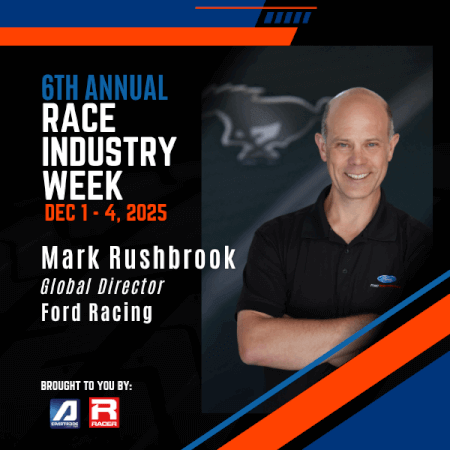
During Race Industry Week, Mark Rushbrook, Global Director, Ford Racing, delivered a sweeping update on Ford’s expanding global motorsports strategy, highlighting a historic period of transformation that includes Ford’s return to Formula 1 in 2026, the launch of its Hypercar program for Le Mans in 2027, continued domination in off-road racing, and an ever-growing Mustang racing footprint across multiple championships worldwide.
Rushbrook summarized 2025 as one of the most dynamic seasons in recent Ford Racing history — marked by strong global competition, the debut of the Raptor T1+ at the Dakar Rally, podium success on its first attempt, and intense preparation for some of the most ambitious factory programs Ford has launched in decades. In a significant organizational shift, Ford officially unified all motorsports operations under the Ford Racing name, fully integrating racing, engineering, marketing and production performance into a single business unit to accelerate real-time technology transfer.
Formula 1: Ford’s Return to the Pinnacle of Motorsport
Ford Racing’s return to Formula 1 in 2026 with Red Bull Racing and Racing Bulls represents one of the most closely watched factory comebacks in modern motorsport. Rushbrook confirmed that development of the all-new Red Bull Ford Power Unit has been underway for nearly three years at Red Bull’s headquarters in Milton Keynes, with intensive simulation, dyno testing, calibration and hybrid system development already producing highly encouraging results.
Despite the massive amount of pre-track work completed through simulation and bench testing, Rushbrook emphasized that January 26, 2026 will be the program’s first true validation when the full chassis finally hits the racetrack. Just two weeks later, a second Bahrain test will demand rapid technical iteration, placing enormous pressure on both reliability and development speed.
Ford’s approach to F1 emphasizes full transparency and deep collaboration with Red Bull. What began as a short list of shared engineering projects has grown into an expansive portfolio of joint solutions across powertrain development, materials science, software, calibration and battery systems — while simultaneously feeding future production vehicle innovation.
Hypercar and Le Mans: Factory Return at the Top Level for 2027
Ford’s highly anticipated return to the top echelon of sports car racing will arrive in 2027 with a full Ford Hypercar program. Ford has selected Oreca as its chassis partner, with full powertrain design, development and manufacturing being conducted in-house in Dearborn, Michigan.
Rushbrook confirmed that aerodynamics and styling development are progressing jointly between Ford’s design studios and Oreca’s engineering teams, ensuring the car delivers both top-tier performance and unmistakable Ford identity. Additional program details, including full driver lineup and car unveiling, will be announced at Ford’s major launch event in Detroit at Michigan Central Station in January.
NASCAR, Mustang and North American Racing
NASCAR remains a foundational pillar of Ford Racing’s U.S. operations. While 2025 delivered competitive wins and playoff appearances, the organization is already aggressively focused on reclaiming championship momentum in 2026 through enhanced technical collaboration with its partner teams.
Rushbrook reaffirmed the importance of Mustang as Ford’s global racing platform, extending across NASCAR, Australian Supercars, NHRA and sports car racing worldwide. Mustang remains one of the most valuable motorsports marketing assets in the world, directly tied to customer engagement and showroom sales.
Off-Road Racing: Raptor, Ranger and Dakar
Off-road racing has become one of Ford’s most powerful brand connection platforms. From the birthplace of the Raptor at Baja, to blistering success at King of the Hammers, and multiple championship victories at Australia’s Finke Desert Race, Ford continues to connect race-proven durability directly to consumer trucks.
The Dakar Rally, however, stands apart as the ultimate test of both machine and human endurance. Rushbrook described the extreme logistical and physical demands of rally-raid competition, where race vehicles cover 300–500 kilometers per day while the entire paddock relocates nightly across vast desert landscapes. For Ford, Dakar embodies the company’s identity as both a performance and people-driven organization.
Electric Demonstrators: SuperVan, SuperTruck and High-Voltage Innovation
Ford’s electric racing demonstrators — including SuperVan 4, SuperTruck, and the Super Mach-E — serve as mobile laboratories unconstrained by traditional racing regulations. These programs have delivered record-breaking performances at Pikes Peak, Goodwood, the Nürburgring, and Bathurst, while accelerating Ford’s understanding of battery systems, thermal management and power electronics under extreme load.
Rushbrook emphasized that Ford intentionally chose demonstrator programs over full EV racing series in order to maximize creative engineering freedom, allowing Ford to explore the full performance envelope of electrification while directly informing future road-going performance vehicles.
Racing as a Technology Engine for Ford’s Future
At the core of Ford Racing’s modern mission is the concept of human and technological development. Engineers, software specialists and calibration experts cycle between racing programs and production vehicle programs, gaining invaluable real-time experience in high-pressure environments where performance is measured every race weekend.
From internal combustion to hybrid systems to full electrification, Ford’s global racing footprint allows the company to stress-test every propulsion technology in competitive conditions. The knowledge gained across F1, Hypercar, NASCAR, off-road racing and electric demonstration programs feeds directly into Ford’s production vehicles and long-term electrification strategy.
A Global Racing Organization Built for the Next Generation
Ultimately, Rushbrook described Ford Racing as a fully integrated business ecosystem — one that connects motorsports, production performance vehicles, customer engagement, technology transfer and talent development into a unified global strategy.
With Formula 1, Le Mans Hypercar, Mustang racing, off-road competition and electric innovation all converging within the next two seasons, Ford Racing is entering one of the most ambitious eras in its 125-year motorsports history.