



Racing Legend Danny Sullivan Closes Day One of Race Industry Week with Great Insights
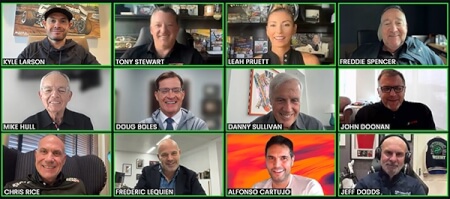
Race Industry Week closed out its opening day with a powerful and wide-ranging conversation featuring Danny Sullivan – 1985 Indianapolis 500 winner, 1988 CART champion, former Formula 1 driver, broadcaster, steward and lifelong ambassador of the sport.
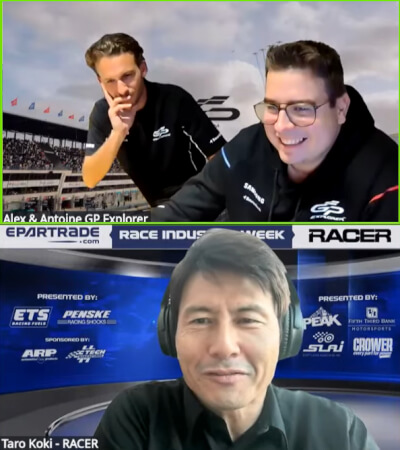
Interviewed by Brad Gillie and introduced by Francisque Savinien and Judy Kean, Sullivan walked attendees through a remarkable career that spans from his late start in racing at age 21 to his years helping shape modern Formula 1 as a driver steward, and his ongoing work connecting generations across the motorsports world.
From the Cockpit to the Steward’s Room
Sullivan began by discussing his 14-year stint as a Formula 1 driver steward, a role he stepped away from two seasons ago.
He described the job as “daunting, stressful, tough” – and very different from the public perception.
“People need to understand: it’s not just the ‘driver steward’ making a call. There’s a panel of four stewards, and we have a huge amount of data: every in-car camera, throttle traces, brake pressure, steering inputs, radio, and driver interviews. The decisions are made collectively and based on facts, not favoritism.”
He emphasized that in all his years in the room he never saw bias or “buddy calls,” but noted how intense the environment has become – especially with social media scrutiny and championship-level consequences riding on each ruling.
When technical issues arise, Sullivan reminded viewers that most of those decisions are driven by the FIA technical department, not the stewards:
“On things like plank wear or legality of parts, that’s Joe Bauer and his team. They inspect those cars constantly. If something’s out of tolerance, it’s pretty black-and-white.”
Abu Dhabi 2021: What Really Belonged to the Stewards
Sullivan also addressed the controversial 2021 Formula 1 season finale in Abu Dhabi, clarifying an important misconception:
“The stewards never made a decision about the safety car procedure in that race. That was entirely in the hands of the race director. We only get involved once something is formally referred to us.”
He explained how the choice to selectively wave by lapped cars and restart the race effectively placed Max Verstappen – on fresh tires – directly behind Lewis Hamilton on heavily worn rubber:
“From my perspective, that decision essentially gifted Max the championship. Max did nothing wrong – he just took the opportunity that was given. But by the letter and spirit of the regulations, it wasn’t a call I agreed with.”
At the same time, he expressed empathy for race control under intense pressure at the end of a long, hard-fought season:
“You’re 23 races into the year, last laps of the last race, and everyone in the world is shouting in your ear. It doesn’t excuse the decision, but it explains the environment.”
A Storyteller and Connector Across All Forms of Racing
Away from officiating, Sullivan continues to contribute to the sport as a broadcaster, host and storyteller.
He reflected on his work on SiriusXM’s “Racers Roundtable” with Tony Stewart and digital content projects with RACER, calling it one of the most rewarding phases of his post-driving career:
“The magic of this sport is the sheer diversity of disciplines – IndyCar, drag racing, sprint cars, modifieds, sports cars, you name it. Every category has its own legends and crazy stories. Being able to sit down with those people and share those stories is something you don’t get in stick-and-ball sports the same way.”
Those shows also deepened his friendships – Stewart among them – and created new links between generations of drivers, teams and fans.
Spotting Talent: The Red Bull Driver Search and Patrick Long
Sullivan played a key role in the early 2000s Red Bull Driver Search, which launched American drivers into the global spotlight.
He recalled organizing the final evaluation at Paul Ricard, where a young Patrick Long caught Porsche’s attention—but not by accident:
“I convinced Porsche to come look at our finalists and told them, ‘You can’t take anyone in the top four from the program.’ Patrick had been top four all the way through, then on the final new-tire test he slipped to about fourth-and-a-half. Porsche said, ‘We want to talk to Patrick.’ And the rest is history.”
Scott Speed, who won the search, went from Skip Barber instructor to Formula 1 in just over two years—one of the fastest American climbs to the top level in modern times.
Sullivan used that example to underscore how quickly a driver can progress today with the right backing, tools and commitment.
Sims, Seat Time and the New Generation
The conversation turned to simulators and how younger drivers train and progress compared to Sullivan’s era.
“If I were 21 today, I’d have already spent a ton of time on a sim. You can learn tracks, braking points and car behavior without burning fuel, tires or engines. When it goes wrong, you just hit reset.”
He cited Jeff Gordon’s famous test in the Williams F1 car, where Gordon did only about nine laps and was still within a second of Juan Pablo Montoya thanks in part to extensive simulator prep—especially on braking.
Still, Sullivan believes nothing replaces real seat time and admires drivers like Kyle Larson who race nearly everything, everywhere:
“Larson would run 10 different cars a week if you let him. That kind of real-world experience is irreplaceable. The sim is a powerful tool—but it doesn’t replace racing.”
He contrasted today’s pipeline—where drivers are expected to be F1-ready by 18–21—with his own path:
- He didn’t drive a race car until age 21,
- Became an F1 rookie at 33,
- Won the Indianapolis 500 at 35,
- Raced DTM at 54,
- And ran Baja into his late 50s.
“In my era, you could come in late and still reach the top. In today’s system, I’d never have had that chance. The whole sport has shifted younger.”
Driving Then and Now: From Lauda’s Ferrari to Modern GT Cars
Sullivan shared vivid contrasts between the machines of his era and today’s high-tech racers.
At the Goodwood Festival of Speed, he recently drove both:
- Niki Lauda’s 1972 flat-12 Ferrari F1 car, and
- His own 1985 Indy 500–winning March, complete with his original seat.
“Sliding back into my Indy car with the same seat – it felt like I’d driven it yesterday. Then Scott Speed climbed in and said, ‘You guys were crazy to race these things.’ The safety envelope and tech now are on a completely different level.”
By contrast, he described stepping into a modern Ferrari 296 Challenge car at Laguna Seca:
“I literally had to ask how to turn it on. There are so many modes, maps and settings. In my day, the steering wheel had an on/off switch and a radio button. That was it.”
He admitted that if he drove a current F1 car, his neck would probably last two laps under the braking and lateral G-forces generated by today’s machines.
The Indy 500: The Win and the One That Got Away
Naturally, the conversation returned to Indianapolis.
While his famous 1985 “spin and win” is the moment that defined him to millions, Sullivan pointed to 1988 as the race he still thinks about:
“’88 is the one that got away. I started on the front row with Mears and Unser and had one of those cars you get maybe once in a career – I could go high, low, do anything. I had a big lead and then the rear wing mount broke going into Turn 1 around lap 90. That one still stings.”
He was quick to balance luck and heartbreak:
“I was unlucky in ’88, but incredibly lucky in ’85. I spun in front of Mario and didn’t hit anything. You remember the ones that slip away as much as the ones you win.”
Strategy, Pressure and Split-Second Calls
Sullivan drew parallels between stewarding decisions and race strategy, highlighting how little time teams have to make season-defining calls.
He pointed to recent high-profile strategic debates in Formula 1:
“The strategist at the front has maybe 10–15 seconds to decide under a safety car: do we pit, do we stay out? You don’t have the luxury of two hours of replays and data like the TV guys do after the race. Whether it’s F1, IndyCar or sports cars, those quick calls can make or break a championship.”
That tension, Sullivan believes, is part of what makes modern motorsport so compelling—and why championships remembered decades later are often the ones that went right down to the wire.
Still Giving Back to the Sport
From stewarding and broadcasting to talent programs and historic events, Danny Sullivan’s message to the Race Industry Week audience was clear: his connection to the sport is ongoing.
“I’ve been lucky to live this life—from learning late, to driving F1 and Indy, to helping guys like Patrick Long get their shot. Now it’s about giving back, sharing what I’ve learned, and helping the next generation make their own stories.”
Race Industry Week continues all week long with more interviews, technical sessions and industry discussions available through EPARTRADE and its partners.